
The Future of Work in the Age of AI
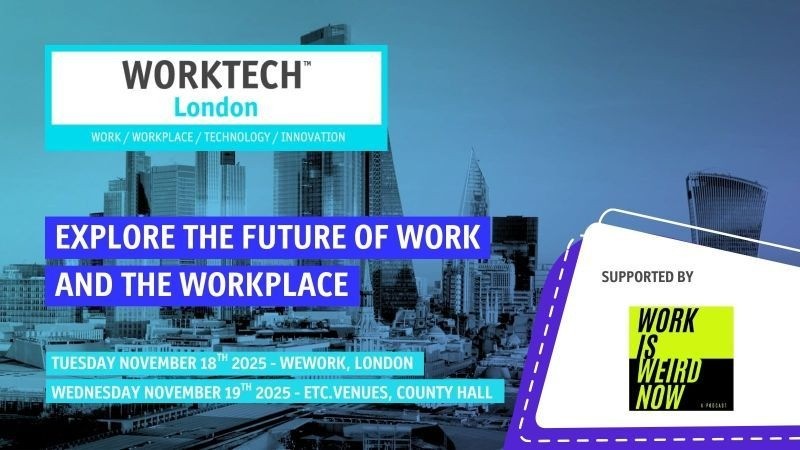
At WORKTECH London 2025, I joined The AI Workplace Challenge—Solving the Future, Live, an interactive session hosted by the Work Is Weird Now podcast. The panel debated real workplace challenges and developed recommendations with the audience.
This is the framework I brought to the discussion.
1. What is the most important consideration for the future workplace in the age of AI?
Task redesign, not job replacement.
AI does not replace roles neatly. It reshapes the task mix. The organisations that thrive will:
- Map which tasks AI can perform reliably.
- Identify the human tasks that become more valuable.
- Continuously rebundle work as AI evolves.
This avoids the twin traps of over-automation, which can damage trust and capability, and under-automation, which leaves large productivity gains unrealised. DeepFlow is designed to help organisations see and redesign work at this level.
2. What is the ideal role for humans in a largely AI-operated workplace?
Humans become the sense-makers, standard-setters and accountability layer.
We contribute:
- Direction-setting: goals, values and definitions of “good”.
- Judgment: ambiguity, trade-offs and nuance.
- Relationship work: trust, empathy and conflict resolution.
- Integration: connecting decisions across contexts and time.
AI does the doing; humans do the deciding. Our value shifts from execution towards interpretation and alignment.
3. How should HR and talent leaders prepare people for this future?
Build a continuous learning and adaptation system, not a one-off training course. That means:
- AI fluency for everyone.
- Regular role and task audits to guide upskilling and workforce design.
- Durable human capabilities such as judgment, communication and problem-framing.
- Psychological safety so people can experiment confidently with AI.
If HR can operationalise continuous adaptation, the workforce can remain relevant even as AI accelerates.
The session brought together Slavina Racheva, Rob Anderson, and me, with moderators Alice Phillips and Danielle Emery. Alexander Szukalski provided live visual storytelling while an AI demonstration explored possible solutions in real time.
The useful shift is from asking which jobs disappear to asking how the task mix should keep changing.